NATALIA ZAGORSKA-THOMAS
In Absentia
Solo show
Tabula Rasa Gallery London
3 December 2025 – 30 January 2026
In Absentia
Solo show
Tabula Rasa Gallery London
3 December 2025 – 30 January 2026
CONVERSATION WITH NATALIA
The following text is an excerpt from an interview conducted by Dawn Ades with Natalia Zagorska-Thomas at her studio in December 2025. It is part of an ongoing dialog between the art historian and the artist.
![]()
From Left to Right:
Untitled, Mixed media with an egg shell, 6 x 13 x 6 cm
Untitled, Mixed media wirh lemon rind, 8 x 18 x 6 cm
Untitled, Mixed media with a glass cherry, 6 x 12.5 x 8 cm
DA
Natalia, we are talking together for the first time. I wonder if you would tell me a little bit about your formation. I know you're an artist as well as an art conservator for many important museum collections. But is that how you began, or did you train as an artist?
DA
When you were at art school, were you primarily a painter?
DA
Yes, you have a very distinctive approach to objects of all kinds. The objects you've been collecting, assembling and disassembling have a particular quality of having been discarded, perhaps?
![]()
Natalia Zagorska-Thomas, Untitled, Leather shoe, wired paper, wax paintbrush, 34.5 x 13.5 x 20.5 cm
![]()
Natalia Zagorska-Thomas, Untitled
DA
Your very strong sense of history and how that history affects us, even if you weren't actually experiencing it yourself, is part of the way you see the world?
DA
I'm not sure if I'm right about this, but in your more recent work, like 'the bags for life', it seemed to me to relate to the huge problem of plastic in the world.
N Z-T
It’s part of a continuum. Remaking and reconstructing something which is damaged or no longer useful is a very potent tool for making meaning. In the case of the Bags for Life it is about our current horrified fascination with the growing detritus of civilisation which is now threatening to choke the planet. But Bags for Life are still an attempt at a resurrection, at finding value, beauty and meaning in something considered useless, spent and discarded.
And I’m also interested in the tension between so called ‘noble’ and ignoble materials. Specifically, the idea that important or universal themes are somehow better contained or expressed through marble than a torn shopping bag. There is a world of social, political, economic and patriarchal assumptions there I want to scratch at. It’s not a new idea but it turns out these hierarchical assumptions are very tenacious. I want to do it through nuanced, visual means. I want each object to be a work of art not a manifesto.
DA
One of the really striking things about the works we've just been looking at in your studio, some of which will be in the exhibition, is that they are not necessarily unique freestanding pieces. They interrelate with each other. You move things around, you introduce items to each other
![]()
Tadeusz Kantor, Children at their desk from the Dead Class, 1975
DA
And that's the other side of it, of course, because I'm not sure whether one first responds to them as a found or chosen object, or to the fact that they're very beautifully and wonderfully put together and made. So you've got those two things running side by side. They're not just objects that you've picked up wherever. You've turned them, you've transformed them.
DA
There is almost a paradoxical aspect, it seemed to me, in that they both demonstrate their innate qualities of delicacy and ephemerality, as with the case of the butterfly for example, or your own hair, but then you put it together with something else and there's a different charge. Things become more challenging. They change their nature in some form. I was just thinking about your lace mincing machine—so you've both got a reference to something we can recognize, but the materials that are making it up are completely different.
DA
Yes, that's really very interesting. But then these wonderful textiles encounter something very hard and sharp, like broken glass. And that's a particular kind of contrast.
![]()
Specimen, Mixed media with an insect, 6 x 19 x 7 cm
DA
There is also a very strong formal interest in your work, is that fair?
DA
Yes, things that you think are beautiful, and things that perhaps are not innately beautiful, you can make beautiful by adding something to them.
DA
So you find that the object has its identity. It's had a life, it's lived, it's had things happen to it, and then you do something else for it.
DA
That is very interesting. I can't help thinking—I'm not sure how useful a comparison this is—but how very different it is from Joseph Cornell's boxes, for example, which I love. It seems to me that he is constructing something, assembling them, enclosing them, according to an idea of his own, whereas it seems to me that with you there's a much more generous and extended interest in what that object has been and what it might be and how it might live again.
Exactly. So the objects tend to take on a more or less fixed meaning in the work of those artists, in a context created by the artist. One’s response to Cornell, for example, might be 'Oh, that's how Joseph Cornell thinks about the cosmos'.
Who would you say…
DA
He is not somebody who's repeating himself in order to sell more works.
DA
It's not as if you'd taken up textile conservation just in order to have a career.
![]()
Jabot, Padded kid glove, silk handkerchief, approx. 40 x 40 cm
DA
How long did that take?
DA
So before you became a textile conservator, working with objects had always been part of it, but when you returned, it was different.
DA
And just a quick question which may not be relevant to the interview as a whole, but I'm interested in the way conservation practices and approaches change over the decades, and how recently you don't disguise the fact that something's being conserved in quite the same way that they used to.
![]()
Untitled, Mixed media with a butterfly, 9.5 x 12 x 9.5 cm
DA
So it's very specific to each case.
DA
Completely fascinating. Very interesting. Then I wanted to ask—there's something you were saying about remembering your grandparents and particular kinds of beautiful ceramic and glassware and so on. It does seem to me that among your incredibly wide range of different objects that you collect and have been drawn to, there is a sort of memory for me of Europe in the '30s, before everything went horrible. My uncle imported wonderful Eastern European and German ceramics and porcelain and so on. The beautiful broken glasses reminded me very much of them. They have a very strong aura. I don't know how many people would pick that up.
DA
Each type of object has different qualities, associations and histories. I’m curious about lace – your ideas about lace – which you have linked to plastic?
DA
So have you done a lot of work with lace conservation?
DA
Has chance played a role in your choice of objects?
![]()
Kiss Kiss Bang Bang, Mixed media with lipstick and powder compact, Dimensions variable
Download PDF
ABOUT THE INTERVIEWER
Dawn Ades (CBE, FBA) is a distinguished British art historian specializing in Dada, Surrealism, and modern art. She served for many years as Professor of Art History and Theory at the University of Essex and is now Professor Emerita. In addition to her academic career, she has curated and contributed to numerous major international exhibitions and is the author of several influential and widely acclaimed publications in the field.
ABOUT THE ARTIST
Natalia Zagorska-Thomas is a London-based Polish-British artist, curator and textile conservator whose practice spans mixed media, installation and performance. She holds a BA in Fine Art from Central Saint Martins and an MA in Textile Conservation from the Textile Conservation Centre at the University of Southampton. She is also the founder and curator of Studio ExPurgamento, an independent exhibition space in Camden Town presenting work by both international and UK-based artists.
Her artistic practice is shaped by her long-standing experience in conservation and the museum sector. As a textile conservator, she has worked with institutions including the Royal Academy of Arts, the Victoria and Albert Museum, the Museum of London, Wawel Royal Castle in Kraków, the Museum of Islamic Art in Doha, the National Trust, Zenzie Tinker Textile Conservation Ltd., and the Royal Collection.
Selected solo exhibitions include: Fitzrovia Chapel, (London, 2026, Upcoming); In Absentia, Tabula Rasa Gallery (London, 2025);Effectos Personales, Centro de Artes Plásticas y Diseño (Havana, 2018); ExPurgamento, Richard Booth’s Gallery (Hay-on-Wye, 2011).
The following text is an excerpt from an interview conducted by Dawn Ades with Natalia Zagorska-Thomas at her studio in December 2025. It is part of an ongoing dialog between the art historian and the artist.
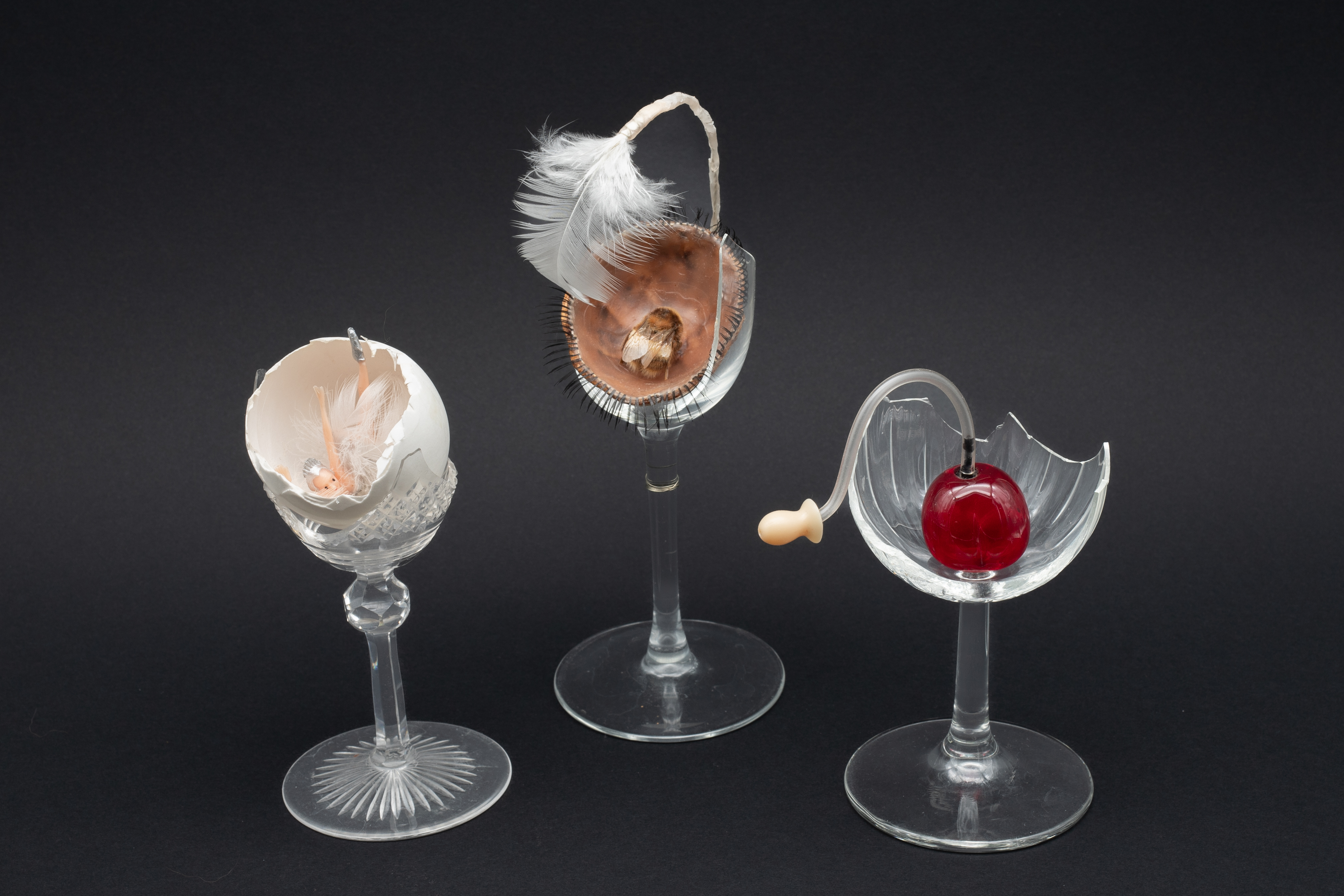
From Left to Right:
Untitled, Mixed media with an egg shell, 6 x 13 x 6 cm
Untitled, Mixed media wirh lemon rind, 8 x 18 x 6 cm
Untitled, Mixed media with a glass cherry, 6 x 12.5 x 8 cm
DA
Natalia, we are talking together for the first time. I wonder if you would tell me a little bit about your formation. I know you're an artist as well as an art conservator for many important museum collections. But is that how you began, or did you train as an artist?
N Z-T
The two run parallel in my life. I went to art school first and I was a full time artist with occasional side-jobs for a few years. Eventually I realized that some aspects of my work have very practical applications plus I needed a regular pay check. Also, I think I'm the kind of person who needs to be out in the world. I don't think I can sit in the studio 24/7 and stare at my navel. I need to be with other people and I need to feel useful in the world of work somehow. So I became a textile conservator.
The two run parallel in my life. I went to art school first and I was a full time artist with occasional side-jobs for a few years. Eventually I realized that some aspects of my work have very practical applications plus I needed a regular pay check. Also, I think I'm the kind of person who needs to be out in the world. I don't think I can sit in the studio 24/7 and stare at my navel. I need to be with other people and I need to feel useful in the world of work somehow. So I became a textile conservator.
DA
When you were at art school, were you primarily a painter?
N Z-T
Mid 1990’s. Although I was in a painting department, I started making 3D objects almost immediately. No one objected, I think it was clear to everybody from the start that's what I should be doing.
Mid 1990’s. Although I was in a painting department, I started making 3D objects almost immediately. No one objected, I think it was clear to everybody from the start that's what I should be doing.
DA
Yes, you have a very distinctive approach to objects of all kinds. The objects you've been collecting, assembling and disassembling have a particular quality of having been discarded, perhaps?
N Z-T
I tend to use discarded, ordinary or domestic objects which appeal to me in some way. It is partly to do with growing up in the final quarter of the 20th century in Poland. Using poor materials was European art at the time, but in Central Europe it was mainstream, born out of very real circumstances. It was already encoded into the culture by the historical events of the 20th century and before, an ongoing personal and collective attempt at resurrection. I think I just absorbed that aesthetic, before I knew what it meant. It's one of the ways in which collective trauma is passed on—it is absorbed, morphs over time and adapts to new realities. It becomes part of the language. In my case, it became part of my art language even though I personally haven’t experienced much collective trauma. So far. Lucky me.
I tend to use discarded, ordinary or domestic objects which appeal to me in some way. It is partly to do with growing up in the final quarter of the 20th century in Poland. Using poor materials was European art at the time, but in Central Europe it was mainstream, born out of very real circumstances. It was already encoded into the culture by the historical events of the 20th century and before, an ongoing personal and collective attempt at resurrection. I think I just absorbed that aesthetic, before I knew what it meant. It's one of the ways in which collective trauma is passed on—it is absorbed, morphs over time and adapts to new realities. It becomes part of the language. In my case, it became part of my art language even though I personally haven’t experienced much collective trauma. So far. Lucky me.
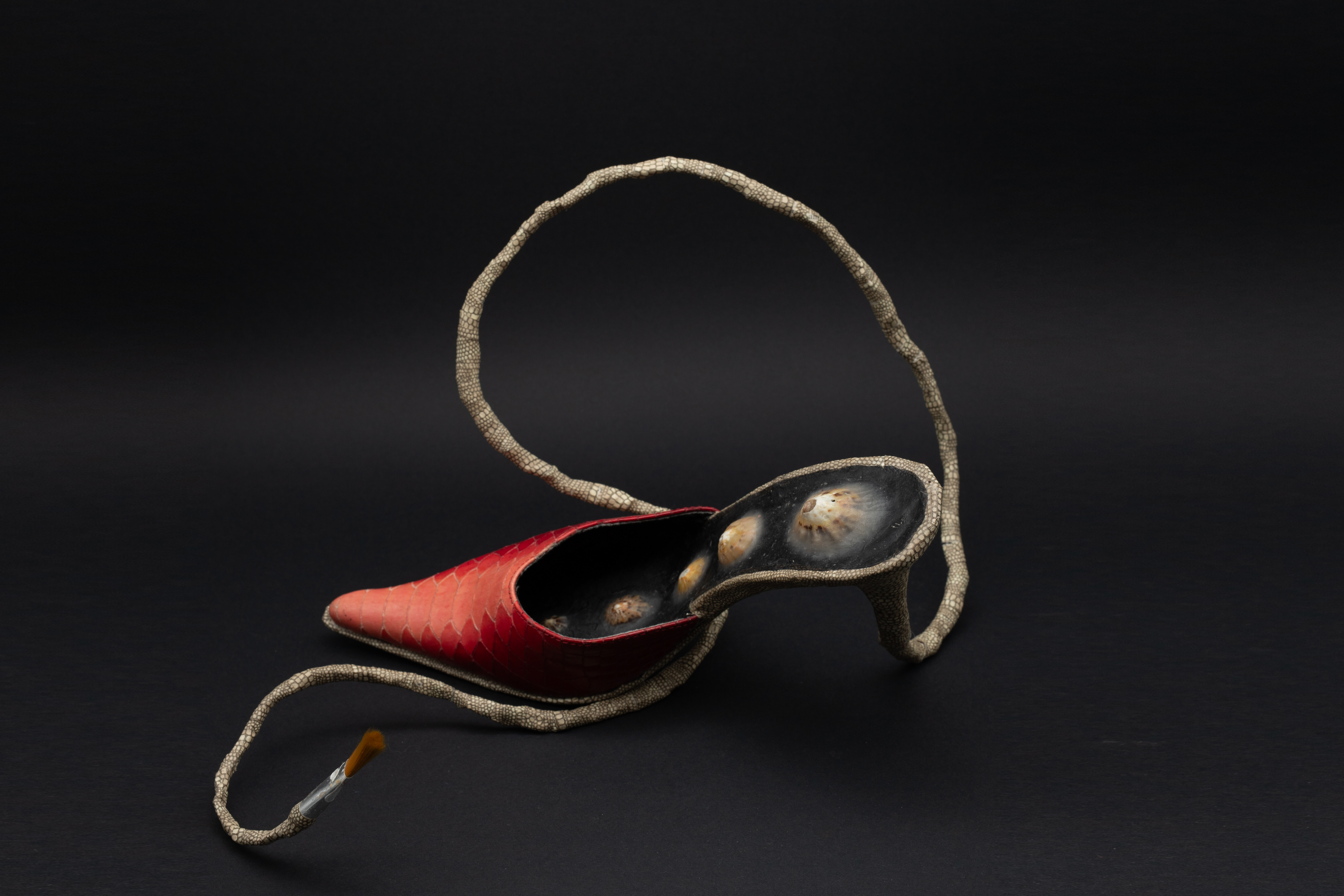
Natalia Zagorska-Thomas, Untitled, Leather shoe, wired paper, wax paintbrush, 34.5 x 13.5 x 20.5 cm
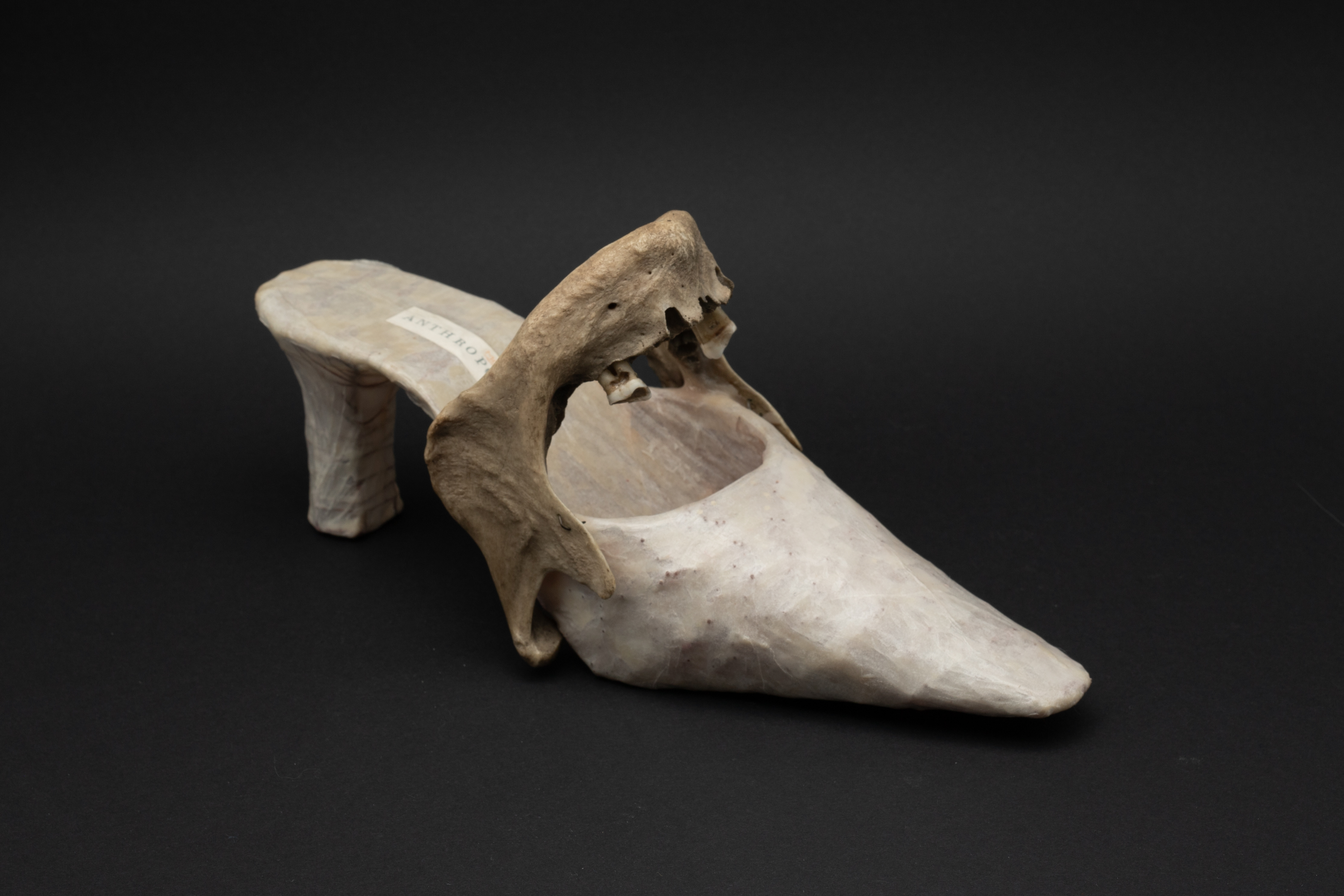
Natalia Zagorska-Thomas, Untitled
DA
Your very strong sense of history and how that history affects us, even if you weren't actually experiencing it yourself, is part of the way you see the world?
N Z-T
The atmosphere of loss and reconstruction was simply in the air. And that fact was often directly referred to: the surviving objects stood as witness to those recent sweeping events and their ongoing consequences.
Polish art and literature is full of it. I don't want to glamorize it because there is a big problem in building a personal or national identity on a sense of loss and victimhood, as we all know. It's as potentially harmful as building it on a sense of power or superiority. I’m just describing a fact: if you are forced to repeatedly reconstruct the present from broken fragments of the past, those fragments become very important in themselves, part of the atmosphere and the language of art.
The atmosphere of loss and reconstruction was simply in the air. And that fact was often directly referred to: the surviving objects stood as witness to those recent sweeping events and their ongoing consequences.
Polish art and literature is full of it. I don't want to glamorize it because there is a big problem in building a personal or national identity on a sense of loss and victimhood, as we all know. It's as potentially harmful as building it on a sense of power or superiority. I’m just describing a fact: if you are forced to repeatedly reconstruct the present from broken fragments of the past, those fragments become very important in themselves, part of the atmosphere and the language of art.
DA
I'm not sure if I'm right about this, but in your more recent work, like 'the bags for life', it seemed to me to relate to the huge problem of plastic in the world.
N Z-T
It’s part of a continuum. Remaking and reconstructing something which is damaged or no longer useful is a very potent tool for making meaning. In the case of the Bags for Life it is about our current horrified fascination with the growing detritus of civilisation which is now threatening to choke the planet. But Bags for Life are still an attempt at a resurrection, at finding value, beauty and meaning in something considered useless, spent and discarded.
And I’m also interested in the tension between so called ‘noble’ and ignoble materials. Specifically, the idea that important or universal themes are somehow better contained or expressed through marble than a torn shopping bag. There is a world of social, political, economic and patriarchal assumptions there I want to scratch at. It’s not a new idea but it turns out these hierarchical assumptions are very tenacious. I want to do it through nuanced, visual means. I want each object to be a work of art not a manifesto.
DA
One of the really striking things about the works we've just been looking at in your studio, some of which will be in the exhibition, is that they are not necessarily unique freestanding pieces. They interrelate with each other. You move things around, you introduce items to each other
N Z-T
I think I know what you mean. In different settings, the works can be put together differently to tell a different story. Each piece is autonomous but it shares the space with others. To me they are like actors in a wordless play. Again, I think this is probably heavily influenced by the Polish 20th century avant guard tradition, especially the work of Tadeusz Kantor, a Polish theatre director and artist who used ordinary objects. I saw his plays when I was still a child and they had a profound effect on me. The performance and the space seemed to me to be one single organism.
It was not a case of human actors speaking lines, surrounded by a set. It was highly orchestrated chaos in which the props were actors, the actors were props, the set changed shape and Kantor himself sometimes remained on stage during the performance, continuing to direct, or perhaps using himself as a prop. So I think it came from that. But each actor to be a fully realised individual, not merely a cog in the machine. It is very important to me that each piece, when removed, is a coherent work of art on its own merits. The objects have to be as well and as elegantly made as I can possibly manage.
I think I know what you mean. In different settings, the works can be put together differently to tell a different story. Each piece is autonomous but it shares the space with others. To me they are like actors in a wordless play. Again, I think this is probably heavily influenced by the Polish 20th century avant guard tradition, especially the work of Tadeusz Kantor, a Polish theatre director and artist who used ordinary objects. I saw his plays when I was still a child and they had a profound effect on me. The performance and the space seemed to me to be one single organism.
It was not a case of human actors speaking lines, surrounded by a set. It was highly orchestrated chaos in which the props were actors, the actors were props, the set changed shape and Kantor himself sometimes remained on stage during the performance, continuing to direct, or perhaps using himself as a prop. So I think it came from that. But each actor to be a fully realised individual, not merely a cog in the machine. It is very important to me that each piece, when removed, is a coherent work of art on its own merits. The objects have to be as well and as elegantly made as I can possibly manage.
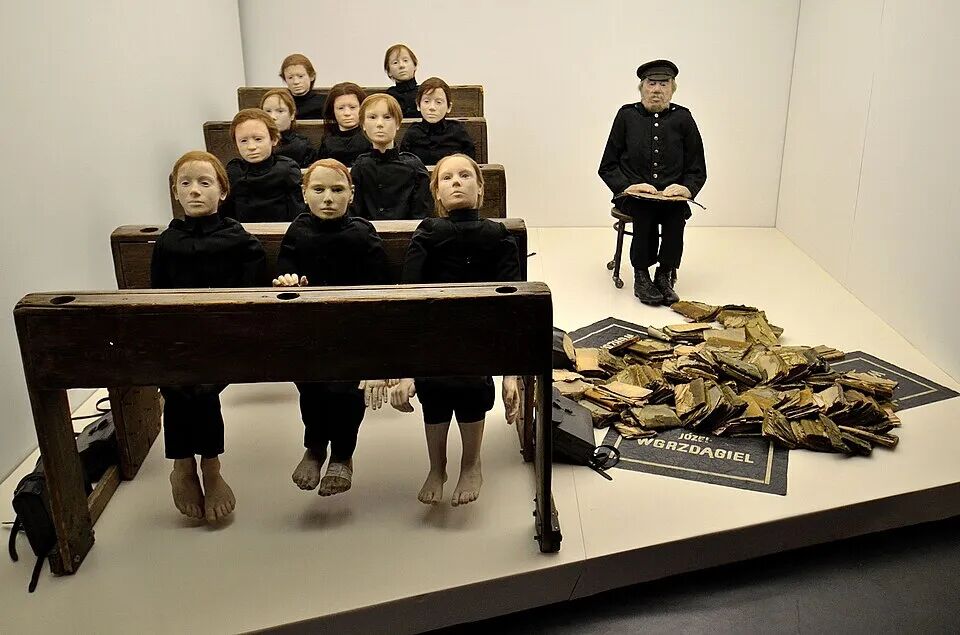
Tadeusz Kantor, Children at their desk from the Dead Class, 1975
DA
And that's the other side of it, of course, because I'm not sure whether one first responds to them as a found or chosen object, or to the fact that they're very beautifully and wonderfully put together and made. So you've got those two things running side by side. They're not just objects that you've picked up wherever. You've turned them, you've transformed them.
N Z-T
I was always interested in skill and the craft inherent in art, but my skill set improved exponentially when I trained to be a textile conservator. Learning about the properties of different materials helped me to know how to manipulate them without compromising their essential nature. That’s the goal, anyway. I don't aim to have total control over the things I make. I want them to still have some identity and agency of their own, though don’t ask me to explain exactly what that means. One of the ways I try to achieve this is that I never break anything on purpose. The damage has to have happened by itself; I only respond to it. It’s an artistic conceit designed to stop me from taking myself too seriously. It wasn’t a conscious decision in the beginning, I only realised that I’m doing this retrospectively, but now it’s part of the process.
I was always interested in skill and the craft inherent in art, but my skill set improved exponentially when I trained to be a textile conservator. Learning about the properties of different materials helped me to know how to manipulate them without compromising their essential nature. That’s the goal, anyway. I don't aim to have total control over the things I make. I want them to still have some identity and agency of their own, though don’t ask me to explain exactly what that means. One of the ways I try to achieve this is that I never break anything on purpose. The damage has to have happened by itself; I only respond to it. It’s an artistic conceit designed to stop me from taking myself too seriously. It wasn’t a conscious decision in the beginning, I only realised that I’m doing this retrospectively, but now it’s part of the process.
DA
There is almost a paradoxical aspect, it seemed to me, in that they both demonstrate their innate qualities of delicacy and ephemerality, as with the case of the butterfly for example, or your own hair, but then you put it together with something else and there's a different charge. Things become more challenging. They change their nature in some form. I was just thinking about your lace mincing machine—so you've both got a reference to something we can recognize, but the materials that are making it up are completely different.
N Z-T
This also wasn’t entirely conscious in the beginning though it certainly is now. Society tends to prioritize certain characteristics over others as though they inherently play a larger role in creating the world. We think that strong, loud, large, long-lasting, big, dangerous are the really important qualities, whilst malleable, foldable, shapeshifting, delicate, ephemeral, nuanced, slow, considered things which are highly responsive to circumstances but also affect them without some single heroic moment of conflagration, are somehow less important. I don’t buy it. I think that all those qualities are strengths. This is one of the reasons I love textiles. A textile is a flat thing which usually hasn’t the strength to stand up on its own, and yet you can hang buildings from it. Individual threads have very low tensile strength yet in a complex network of a weave – they can carry many tons of weight. They are versatile and malleable enough to allow us to make extremely complex three-dimensional objects, such as clothing for example, which can adapt to movement, the environment and take a lot of wear. Tailoring is a form of body engineering. Until recently, you could judge the technological development of an extinct civilisation by the methods it used to produce textiles. The first ever computer was a loom…etc. I could go on. We tend to think of textiles as ephemeral but archaeology as well as engineering prove otherwise. It seems I’m interested in materials which endure despite expectations.
This also wasn’t entirely conscious in the beginning though it certainly is now. Society tends to prioritize certain characteristics over others as though they inherently play a larger role in creating the world. We think that strong, loud, large, long-lasting, big, dangerous are the really important qualities, whilst malleable, foldable, shapeshifting, delicate, ephemeral, nuanced, slow, considered things which are highly responsive to circumstances but also affect them without some single heroic moment of conflagration, are somehow less important. I don’t buy it. I think that all those qualities are strengths. This is one of the reasons I love textiles. A textile is a flat thing which usually hasn’t the strength to stand up on its own, and yet you can hang buildings from it. Individual threads have very low tensile strength yet in a complex network of a weave – they can carry many tons of weight. They are versatile and malleable enough to allow us to make extremely complex three-dimensional objects, such as clothing for example, which can adapt to movement, the environment and take a lot of wear. Tailoring is a form of body engineering. Until recently, you could judge the technological development of an extinct civilisation by the methods it used to produce textiles. The first ever computer was a loom…etc. I could go on. We tend to think of textiles as ephemeral but archaeology as well as engineering prove otherwise. It seems I’m interested in materials which endure despite expectations.
DA
Yes, that's really very interesting. But then these wonderful textiles encounter something very hard and sharp, like broken glass. And that's a particular kind of contrast.
N Z-T
They are different but there's something they have in common: Both are seen as delicate yet they are also very strong. Glass is strong because of its rigidity , impermeability and resistance to heat but it shatters easily, whereas a textile is fluid but it bends and stretches long before it breaks. I often use things with opposing strengths in combination — organic and inorganic together. I’m very aware of the core characteristic of materials, so I exploit the opportunity for creating meaning from these juxtapositions. But to be truthful I think I see them as partnerships not juxtapositions. Different strengths working together.
They are different but there's something they have in common: Both are seen as delicate yet they are also very strong. Glass is strong because of its rigidity , impermeability and resistance to heat but it shatters easily, whereas a textile is fluid but it bends and stretches long before it breaks. I often use things with opposing strengths in combination — organic and inorganic together. I’m very aware of the core characteristic of materials, so I exploit the opportunity for creating meaning from these juxtapositions. But to be truthful I think I see them as partnerships not juxtapositions. Different strengths working together.
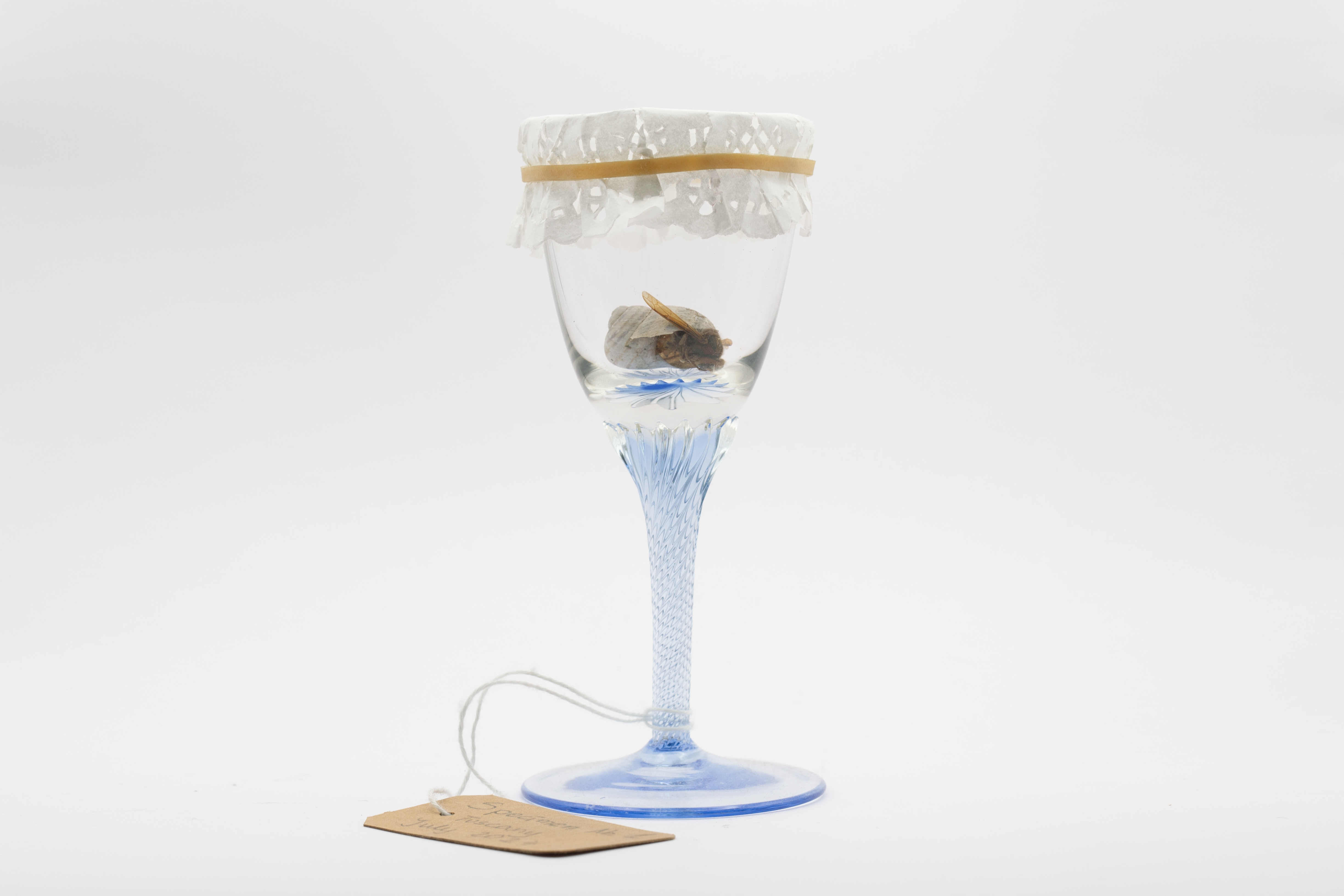
Specimen, Mixed media with an insect, 6 x 19 x 7 cm
DA
There is also a very strong formal interest in your work, is that fair?
N Z-T
For sure, though I'm not a person you’ll ever hear say that form is content. I understand what’s meant by it but taken too literally it’s led us down a very boring and limiting cul-de-sac. Form can be instrumentalising. In a considered work of art it should function as one of the essential components. I’m rarely convinced by work in which form dominates, though there are exceptions.
Anyway, artists often aren’t sure exactly what they want to say or how to say it until they do and even then – not entirely. Mostly we’re just tinkering with the tools and materials we have gathered out of need to communicate a thing we only fully understand through the process of making it. Formal constraints help me to decide if something is working or when it’s finished. I have to be convinced that the elements workin together, that the thing in front of me is now a coherent, self-contained being. The ideal would be if the objects appeared to have evolved by some as yet undiscovered natural process.
I want these things to be made with attention and care as well as to be beautiful, to bring pleasure. Humour is important too, it welcomes people in.
For sure, though I'm not a person you’ll ever hear say that form is content. I understand what’s meant by it but taken too literally it’s led us down a very boring and limiting cul-de-sac. Form can be instrumentalising. In a considered work of art it should function as one of the essential components. I’m rarely convinced by work in which form dominates, though there are exceptions.
Anyway, artists often aren’t sure exactly what they want to say or how to say it until they do and even then – not entirely. Mostly we’re just tinkering with the tools and materials we have gathered out of need to communicate a thing we only fully understand through the process of making it. Formal constraints help me to decide if something is working or when it’s finished. I have to be convinced that the elements workin together, that the thing in front of me is now a coherent, self-contained being. The ideal would be if the objects appeared to have evolved by some as yet undiscovered natural process.
I want these things to be made with attention and care as well as to be beautiful, to bring pleasure. Humour is important too, it welcomes people in.
DA
Yes, things that you think are beautiful, and things that perhaps are not innately beautiful, you can make beautiful by adding something to them.
N Z-T
Generally the things I use are already beautiful to me, so I clearly find damage and loss visually compelling in some way. Damage implies an event, a story, the passage of time so part of the narrative is there already, before I start. That narrative quality of ordinary objects is a large part of what makes them so important as evidence of human activity, why we collect and study them. They are subject to the same reality and go through the same events as us - we can see what we’ve been through by what they've been through. I find scars can be beautiful for similar reasons.
Generally the things I use are already beautiful to me, so I clearly find damage and loss visually compelling in some way. Damage implies an event, a story, the passage of time so part of the narrative is there already, before I start. That narrative quality of ordinary objects is a large part of what makes them so important as evidence of human activity, why we collect and study them. They are subject to the same reality and go through the same events as us - we can see what we’ve been through by what they've been through. I find scars can be beautiful for similar reasons.
As an art conservator I don't generally make objects whole again, my remit is to make them safe for as long as possible. I am supposed to preserve them so that the damage helps to illuminate their history whilst slowing down further deterioration as much as possible. It’s a balance of conflicting priorities. And so I guess I do that in my artwork too, although I have unlimited licence about how and what I put together, it’s an antidote to the rigors of museum ethics.
DA
So you find that the object has its identity. It's had a life, it's lived, it's had things happen to it, and then you do something else for it.
N Z-T
Yes, both in light of and despite that history.
Yes, both in light of and despite that history.
DA
That is very interesting. I can't help thinking—I'm not sure how useful a comparison this is—but how very different it is from Joseph Cornell's boxes, for example, which I love. It seems to me that he is constructing something, assembling them, enclosing them, according to an idea of his own, whereas it seems to me that with you there's a much more generous and extended interest in what that object has been and what it might be and how it might live again.
N Z-T
That's very interesting that you say that, because you may have just explained to me why, despite really liking Joseph Cornell's boxes, he doesn't quite ever get to me.
I think that I'm in some kind of a relationship with the object I’m making, that we’re on the same level. I've never expressed it in that way before, but I think that’s true. Some artists seem to coexist in the world with their work. Others seem outside or above it, they are the creator, like a god. I think I’d like to be the first kind. If that makes any sense.
DAThat's very interesting that you say that, because you may have just explained to me why, despite really liking Joseph Cornell's boxes, he doesn't quite ever get to me.
I think that I'm in some kind of a relationship with the object I’m making, that we’re on the same level. I've never expressed it in that way before, but I think that’s true. Some artists seem to coexist in the world with their work. Others seem outside or above it, they are the creator, like a god. I think I’d like to be the first kind. If that makes any sense.
Exactly. So the objects tend to take on a more or less fixed meaning in the work of those artists, in a context created by the artist. One’s response to Cornell, for example, might be 'Oh, that's how Joseph Cornell thinks about the cosmos'.
N Z-T
Yes. That's very interesting. Thank you, that's really very illuminating for me.
I’m hoping that that what makes my body of work coherent is simply that it is an honest extension of who I am. I don’t know if that’s enough. If people ask, 'Why do you like this or that artist?' I can't always answer sensibly except to say that I trust that artist. It’s a strange word to use and obviously deeply subjective, I trust that they really have shown me something of themselves as honestly as they could. Vulnerability and some kind of risk is part of it somehow. Some time ago I was talking about this with a friend who collects art and he said that practicing artists collect differently, they use different criteria. That struck me as interesting.
DAYes. That's very interesting. Thank you, that's really very illuminating for me.
I’m hoping that that what makes my body of work coherent is simply that it is an honest extension of who I am. I don’t know if that’s enough. If people ask, 'Why do you like this or that artist?' I can't always answer sensibly except to say that I trust that artist. It’s a strange word to use and obviously deeply subjective, I trust that they really have shown me something of themselves as honestly as they could. Vulnerability and some kind of risk is part of it somehow. Some time ago I was talking about this with a friend who collects art and he said that practicing artists collect differently, they use different criteria. That struck me as interesting.
Who would you say…
N Z-T
Erm…Rebecca Horn, Magdalena Abakanowicz, Wladyslaw Hasior. Kantor of course. These are nailed down. There are of course many, many others including artists I know personally and who I repeatedly work with. At the moment I also like William Kentridge though it’s not unqualified.
Erm…Rebecca Horn, Magdalena Abakanowicz, Wladyslaw Hasior. Kantor of course. These are nailed down. There are of course many, many others including artists I know personally and who I repeatedly work with. At the moment I also like William Kentridge though it’s not unqualified.
DA
He is not somebody who's repeating himself in order to sell more works.
N Z-T
No, someone who urgently needs us to know something. And you can see that in the work.
No, someone who urgently needs us to know something. And you can see that in the work.
DA
It's not as if you'd taken up textile conservation just in order to have a career.
N Z-T
No. I already had one. But I knew I had to do something to retain the freedom to continue. I chose something that would be compatible with art because I was also a young mother. Although I have the most collaborative and supportive husband possible, both of us were in the same situation. We had a small child, a mortgage and no financial cushion. We both worked, so there's a lot going on. So I wanted to do something that didn't completely conflict with the art, I didn't think I'd have the psychological space to do both. It took longer than I thought for the two to connect. I thought it would be instantaneous. In reality it took a good few years before the conservation allowed me to start making artwork again, because it was so all-consuming. I fell in love with it so completely that I stopped making my own work. And I needed to establish myself professionally, that was the whole point of it after all.
No. I already had one. But I knew I had to do something to retain the freedom to continue. I chose something that would be compatible with art because I was also a young mother. Although I have the most collaborative and supportive husband possible, both of us were in the same situation. We had a small child, a mortgage and no financial cushion. We both worked, so there's a lot going on. So I wanted to do something that didn't completely conflict with the art, I didn't think I'd have the psychological space to do both. It took longer than I thought for the two to connect. I thought it would be instantaneous. In reality it took a good few years before the conservation allowed me to start making artwork again, because it was so all-consuming. I fell in love with it so completely that I stopped making my own work. And I needed to establish myself professionally, that was the whole point of it after all.
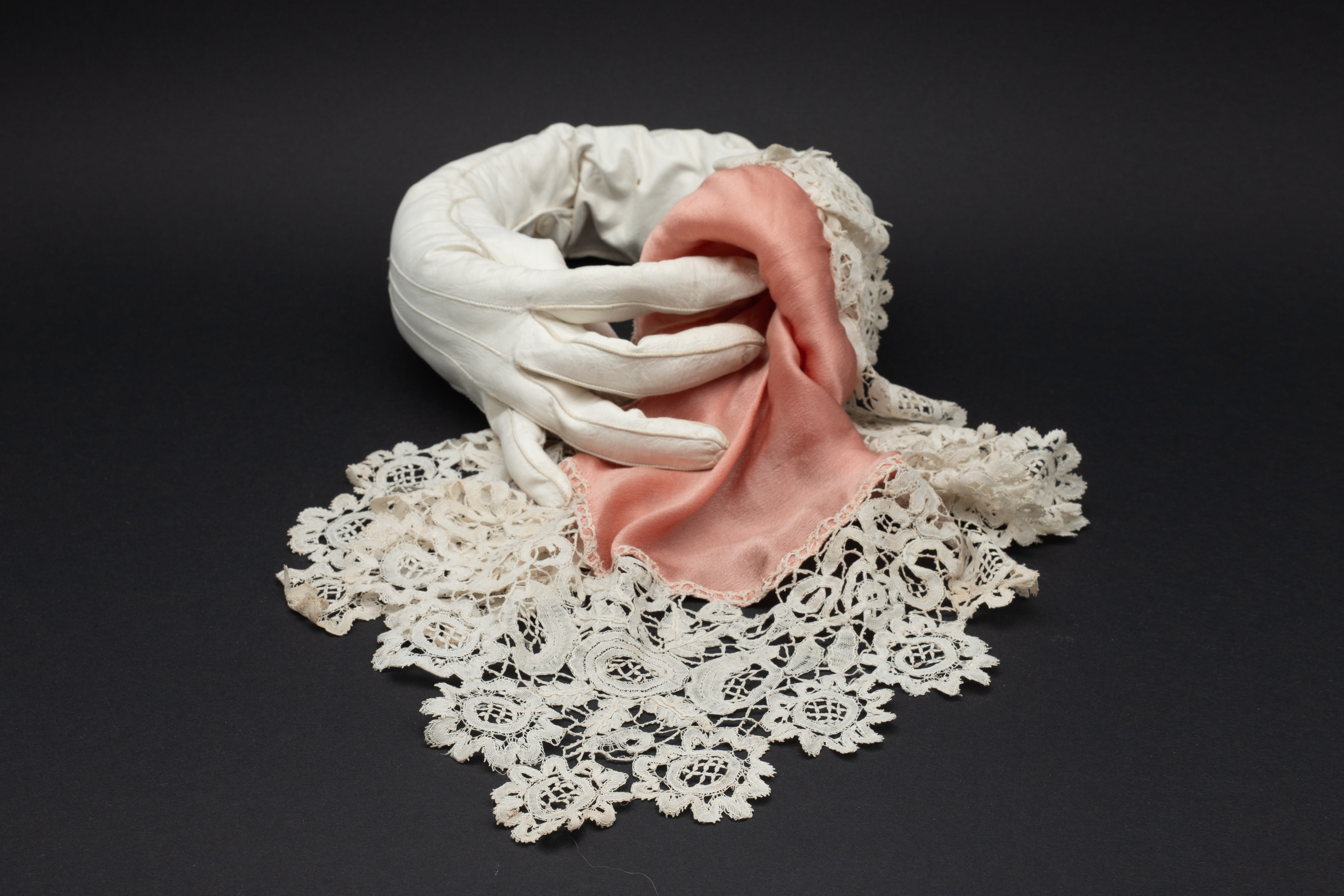
Jabot, Padded kid glove, silk handkerchief, approx. 40 x 40 cm
DA
How long did that take?
N Z-T
Almost a decade, I would say, until eventually the art just started coming back. And suddenly it was a bit different, because it was informed by the conservation.
Almost a decade, I would say, until eventually the art just started coming back. And suddenly it was a bit different, because it was informed by the conservation.
DA
So before you became a textile conservator, working with objects had always been part of it, but when you returned, it was different.
N Z-T
Yes. I knew so much more about museums and the world of collecting. I had much better practical skills and crucially I had much deeper understanding of the materiality of things and how that connects with culture and context. I'd instinctively felt that this is important in my work but I couldn’t pinpoint or articulate it. So I understood myself as an artist much better through the subject of conservation, and it's been wonderful.
Yes. I knew so much more about museums and the world of collecting. I had much better practical skills and crucially I had much deeper understanding of the materiality of things and how that connects with culture and context. I'd instinctively felt that this is important in my work but I couldn’t pinpoint or articulate it. So I understood myself as an artist much better through the subject of conservation, and it's been wonderful.
DA
And just a quick question which may not be relevant to the interview as a whole, but I'm interested in the way conservation practices and approaches change over the decades, and how recently you don't disguise the fact that something's being conserved in quite the same way that they used to.
N Z-T
Previously there was more focus on restoration. There still is but there is a stated difference between the two. Of course at times they blend together, you can't keep them entirely separate because conservation is based on the idea that you minimize physical interference within the object and that anything you do could be reversed. But that's not really possible. If you vacuum a very dirty object, you can't keep the dust and at some future date replace that dust exactly where it was. Just for starters. So it's always an informed compromise. The most important thing about a museum object is its context. If the audience can't see what this object is or represents because it is so damaged, it loses its purpose. It’s a balancing act between the physical demands of the object, its safety/longevity and its meaning, in which aesthetics play a large part. A lot of big treatments do include considerable aspects of restoration for that reason.
Previously there was more focus on restoration. There still is but there is a stated difference between the two. Of course at times they blend together, you can't keep them entirely separate because conservation is based on the idea that you minimize physical interference within the object and that anything you do could be reversed. But that's not really possible. If you vacuum a very dirty object, you can't keep the dust and at some future date replace that dust exactly where it was. Just for starters. So it's always an informed compromise. The most important thing about a museum object is its context. If the audience can't see what this object is or represents because it is so damaged, it loses its purpose. It’s a balancing act between the physical demands of the object, its safety/longevity and its meaning, in which aesthetics play a large part. A lot of big treatments do include considerable aspects of restoration for that reason.
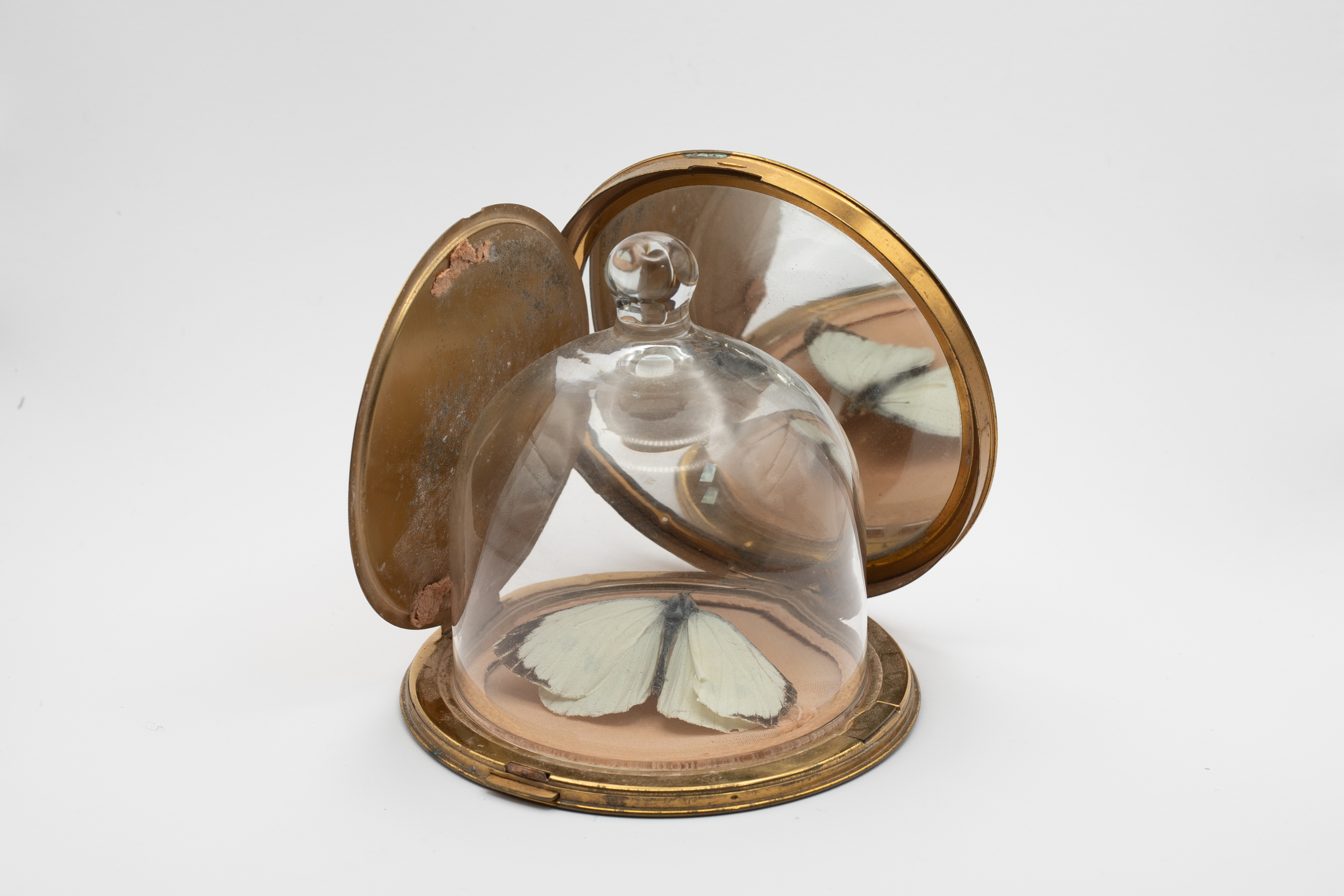
Untitled, Mixed media with a butterfly, 9.5 x 12 x 9.5 cm
DA
So it's very specific to each case.
N Z-T
Yes, the ethics of conserving are a combination of practical skill, science, detective work and ethical enquiry which can get quite philosophical and political, especially when you enter the world of museums, which has a cultural and political dimension. I didn’t fully appreciate it would be like that, and I love it and it had a large impact on my art.
Yes, the ethics of conserving are a combination of practical skill, science, detective work and ethical enquiry which can get quite philosophical and political, especially when you enter the world of museums, which has a cultural and political dimension. I didn’t fully appreciate it would be like that, and I love it and it had a large impact on my art.
DA
Completely fascinating. Very interesting. Then I wanted to ask—there's something you were saying about remembering your grandparents and particular kinds of beautiful ceramic and glassware and so on. It does seem to me that among your incredibly wide range of different objects that you collect and have been drawn to, there is a sort of memory for me of Europe in the '30s, before everything went horrible. My uncle imported wonderful Eastern European and German ceramics and porcelain and so on. The beautiful broken glasses reminded me very much of them. They have a very strong aura. I don't know how many people would pick that up.
N Z-T
People very often do. Nostalgia is pretty universal and therefore a good entry point. Most of my objects function as secular relics, and the fact that they are redolent of an ordinary, domestic past most of us share, seems to relax and invite people into the work.
It was interesting when Eastern Europe opened up in the early 90’s and people used to come for weekends to Krakow, Prague, Vilnius. The mismatched aesthetic was immediately taken up in the UK. It existed here of course but not in the mainstream. Suddenly huge numbers of cafés, bars, restaurants and even high-end shops started decorating everything with mismatched chairs and different tablecloths etc. Domestic décor changed too. Industrial salvage boomed. It was briefly called Iron Curtain Chique. I saw that phrase used at Harrods of all places. People paid a premium to simulate scarcity. So that aesthetic lost a lot of its true meaning, right? But I think the longing that made people respond to it was real and genuine. We all instinctively understand the many messages in “make-do-and-mend”. It’s not unique to any one place. And then the aesthetic took another turn: society became concerned with the amount of rubbish we are producing. So now it's about rubbish, about excess, about saving the world from the detritus of civilisation. So the aesthetic travels and adapts to new realities but at the very base, the core of why we respond to it remains. That’s universality.
People very often do. Nostalgia is pretty universal and therefore a good entry point. Most of my objects function as secular relics, and the fact that they are redolent of an ordinary, domestic past most of us share, seems to relax and invite people into the work.
It was interesting when Eastern Europe opened up in the early 90’s and people used to come for weekends to Krakow, Prague, Vilnius. The mismatched aesthetic was immediately taken up in the UK. It existed here of course but not in the mainstream. Suddenly huge numbers of cafés, bars, restaurants and even high-end shops started decorating everything with mismatched chairs and different tablecloths etc. Domestic décor changed too. Industrial salvage boomed. It was briefly called Iron Curtain Chique. I saw that phrase used at Harrods of all places. People paid a premium to simulate scarcity. So that aesthetic lost a lot of its true meaning, right? But I think the longing that made people respond to it was real and genuine. We all instinctively understand the many messages in “make-do-and-mend”. It’s not unique to any one place. And then the aesthetic took another turn: society became concerned with the amount of rubbish we are producing. So now it's about rubbish, about excess, about saving the world from the detritus of civilisation. So the aesthetic travels and adapts to new realities but at the very base, the core of why we respond to it remains. That’s universality.
DA
Each type of object has different qualities, associations and histories. I’m curious about lace – your ideas about lace – which you have linked to plastic?
N Z-T
What I like is that lace stands for an incredibly laborious, and skilled process but the plastic bag is a mass-produced throwaway object. I’m putting them together because they're more interesting in conversation with each other than they are on their own. People went blind and ruined their bodies making lace and didn’t get paid nearly enough. There is this rather cruel aspect to that level of human investment in beauty and value, versus the equally cruel but much more instantaneous investment in the plastic bag, which creates an interesting tension.
What I like is that lace stands for an incredibly laborious, and skilled process but the plastic bag is a mass-produced throwaway object. I’m putting them together because they're more interesting in conversation with each other than they are on their own. People went blind and ruined their bodies making lace and didn’t get paid nearly enough. There is this rather cruel aspect to that level of human investment in beauty and value, versus the equally cruel but much more instantaneous investment in the plastic bag, which creates an interesting tension.
DA
So have you done a lot of work with lace conservation?
N Z-T
I have, because there are a lot of wedding dresses in the world. But also I worked on a lace exhibition for the Benaki Museum in Athens. The Victoria and Albert Museum were lending quite a lot of lace to the Benaki Museum in the early 2000’s. Many pieces needed conservation and specialist packing to travel to Greece. As a newly minted conservator, I was part of a team who worked on that. I learned a lot about washing very old lace. It was scary.
I have, because there are a lot of wedding dresses in the world. But also I worked on a lace exhibition for the Benaki Museum in Athens. The Victoria and Albert Museum were lending quite a lot of lace to the Benaki Museum in the early 2000’s. Many pieces needed conservation and specialist packing to travel to Greece. As a newly minted conservator, I was part of a team who worked on that. I learned a lot about washing very old lace. It was scary.
DA
Has chance played a role in your choice of objects?
N Z-T
Well, I have to come across them, so that's the biggest chance. But after that I have to choose to work on them. Sometimes they wait several years before I suddenly have an idea. Part of my process is to periodically look at all the things I’ve collected, it takes a couple of days and often leads to new ideas because I see some of these things anew. Rebecca Horn had a studio big enough to have most of the things she collected out on display, easy to find at all times. I am jealous of that. My studio is very nice but small.
About menace and danger—life is dangerous and scary. Some juxtapositions come from the shock of recognition: like the extraordinary similarity of a bullet case and a lipstick holder. The relationship between the real violence of the bullet vs. fear of female sexuality, even a performative, supposedly compliant femininity as expressed by red lipstick. There is that ridiculous saying: “The female of the species is much deadlier than the male” which applied to humans is just nonsense. There is this underlying narrative that female sexuality is secretly more dangerous than overt male violence though no one will spell out exactly how.
The narrative is that there is some kind of equivalency between violent need to dominate and refusal to be dominated, even though there obviously isn’t. It’s a good magic trick, isn’t it? This kind of projection and inversion of moral logic is so ingrained, it’s such an intricate network of total nonsense that if you try to unravel it – you are the one who appears insane. I suppose I am often searching for ways of expressing that somehow, without being too literal. I can’t really think of a more universal issue, yet talking about it is treated as a niche interest. Just talking about your own life while being a woman is considered a side issue and as such – a political act in opposition to the main narrative.
Well, I have to come across them, so that's the biggest chance. But after that I have to choose to work on them. Sometimes they wait several years before I suddenly have an idea. Part of my process is to periodically look at all the things I’ve collected, it takes a couple of days and often leads to new ideas because I see some of these things anew. Rebecca Horn had a studio big enough to have most of the things she collected out on display, easy to find at all times. I am jealous of that. My studio is very nice but small.
About menace and danger—life is dangerous and scary. Some juxtapositions come from the shock of recognition: like the extraordinary similarity of a bullet case and a lipstick holder. The relationship between the real violence of the bullet vs. fear of female sexuality, even a performative, supposedly compliant femininity as expressed by red lipstick. There is that ridiculous saying: “The female of the species is much deadlier than the male” which applied to humans is just nonsense. There is this underlying narrative that female sexuality is secretly more dangerous than overt male violence though no one will spell out exactly how.
The narrative is that there is some kind of equivalency between violent need to dominate and refusal to be dominated, even though there obviously isn’t. It’s a good magic trick, isn’t it? This kind of projection and inversion of moral logic is so ingrained, it’s such an intricate network of total nonsense that if you try to unravel it – you are the one who appears insane. I suppose I am often searching for ways of expressing that somehow, without being too literal. I can’t really think of a more universal issue, yet talking about it is treated as a niche interest. Just talking about your own life while being a woman is considered a side issue and as such – a political act in opposition to the main narrative.
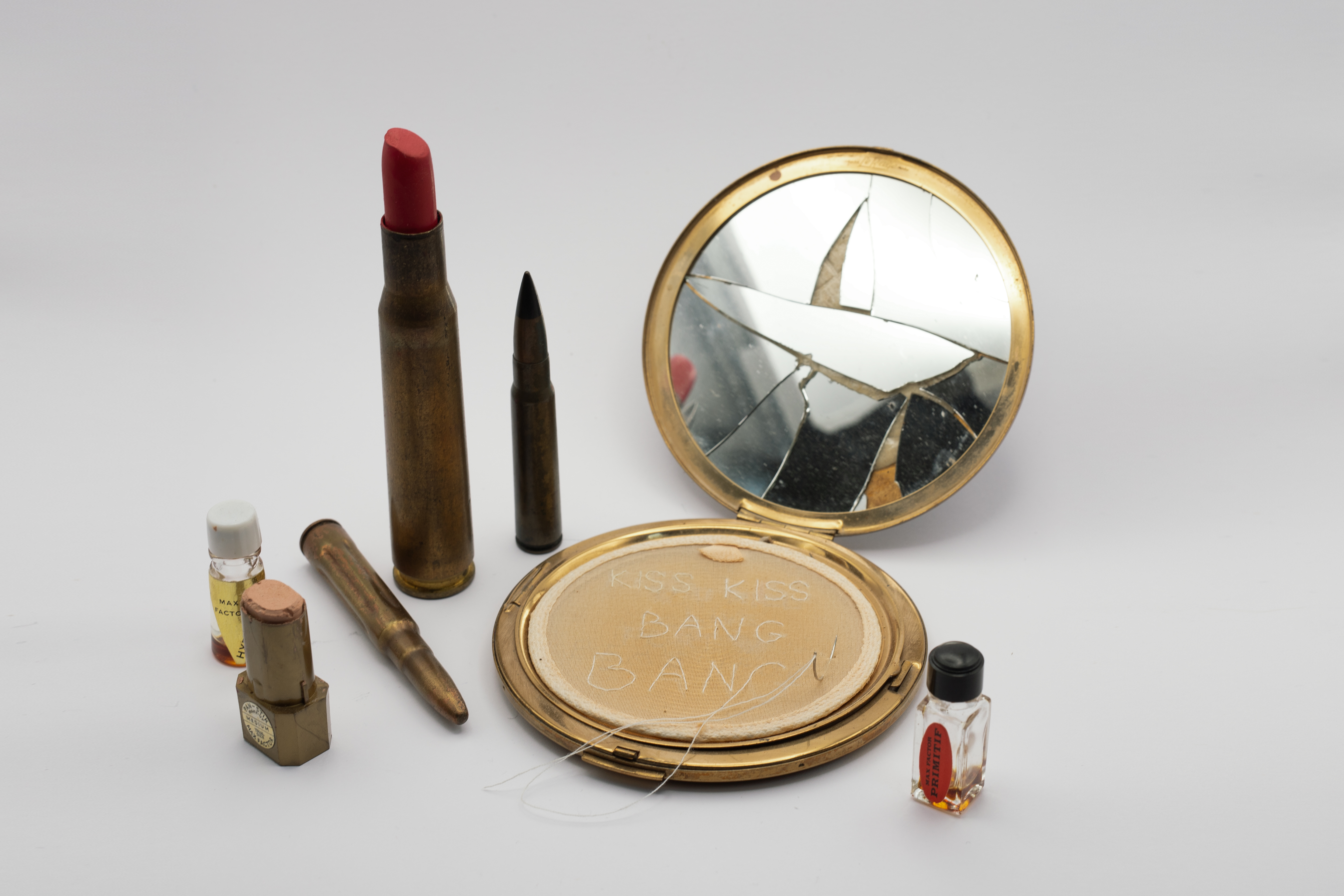
Kiss Kiss Bang Bang, Mixed media with lipstick and powder compact, Dimensions variable
Download PDF
ABOUT THE INTERVIEWER
Dawn Ades (CBE, FBA) is a distinguished British art historian specializing in Dada, Surrealism, and modern art. She served for many years as Professor of Art History and Theory at the University of Essex and is now Professor Emerita. In addition to her academic career, she has curated and contributed to numerous major international exhibitions and is the author of several influential and widely acclaimed publications in the field.
ABOUT THE ARTIST
Natalia Zagorska-Thomas is a London-based Polish-British artist, curator and textile conservator whose practice spans mixed media, installation and performance. She holds a BA in Fine Art from Central Saint Martins and an MA in Textile Conservation from the Textile Conservation Centre at the University of Southampton. She is also the founder and curator of Studio ExPurgamento, an independent exhibition space in Camden Town presenting work by both international and UK-based artists.
Her artistic practice is shaped by her long-standing experience in conservation and the museum sector. As a textile conservator, she has worked with institutions including the Royal Academy of Arts, the Victoria and Albert Museum, the Museum of London, Wawel Royal Castle in Kraków, the Museum of Islamic Art in Doha, the National Trust, Zenzie Tinker Textile Conservation Ltd., and the Royal Collection.
Selected solo exhibitions include: Fitzrovia Chapel, (London, 2026, Upcoming); In Absentia, Tabula Rasa Gallery (London, 2025);Effectos Personales, Centro de Artes Plásticas y Diseño (Havana, 2018); ExPurgamento, Richard Booth’s Gallery (Hay-on-Wye, 2011).
Tabula Rasa Gallery (London)
Unit One, 99 East Road,
Hoxton, London
N1 6AQ
Unit One, 99 East Road,
Hoxton, London
N1 6AQ
Tuesday - Saturday 12:00 - 18:00 | Sunday - Monday Closed
© 2022 Tabula Rasa Gallery